Tisa's Samoan Feast
- EVERY WEDNESDAY
Discover ancient Samoan preparations and cooking oven of the Samoan Feast. You can experience the making of Samoan coconut milk from fresh coconuts and the preparation of delicious ancient recepies.
Everything goes into the "umu" - the traditional oven made from a mixture of hot rocks and food, and covered with leaves. |
|
 |
While your delicious meal is cooking you can learn basket weaving, and you can even weave your own dinner plate. Then, after a couple of hours of the most delicious aromas you can imagine have been wafting through the Bar, you can watch the unveiling of the Samoan Feast. Taste the best tradtional food at Tisa's Barefoot Bar.
Our dinner menu varies week to week, but includes fish, prawns, pork, chicken, lamb, taro, papaya, banana, "all time favorite" palusami, turkey and octopus smothered in coconut cream sauce. The Samoan feast also includes a kava drink. The feast is $29.95 per ticket, and reservations are highly recommended. |
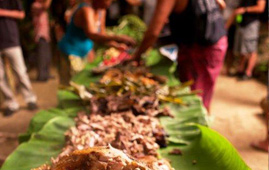
Feast from the Umu
(Credit: Jason Stolte) |
|
Samoan Feast
Every Wednesday. Feast the Samoan Way, with Tisa's tropical specialities.
All of the intensity of Samoan culture and cuisine condensed into a single evening of cooking performance and dining. The Samoan Feast actually begins 3 days earlier, with the collection of a variety of fresh foods, such as taro, bananas and breadfruits. The day of the feast, a large fire is built to heat rocks for the umu. While the rocks are heating (a 2 hour process), coconut milk is made by husking coconuts and scraping the meat out. The coconut meat is then squeezed to get the milk out. Bananas are peeled, and the breadfruit and taro are scraped to prepare them. Palusami, an all-time local favorite, is made by combining baby taro leaves with fresh coconut milk and wrapping in banana leaves. Various meats are cooked, but nearly always include marinated pork stuffed with garlic, well seasoned New Zealand lamb flaps, chicken and fresh fish casserole (fai ai pilikaki). Other meats that may be in the umu include turkey, leg of lamb, fresh local pig and seafood such as octopus.
When all of the food is ready, and the rocks are hot, the umu is built. The hot rocks are leveled in the shape of a circle, with the larger rocks sorted to the outside. The rocks are dusted off (to remove most of the ash), and then covered with a layer of mango leaves. For extra moisture (our secret), fresh banana trunks are shredded and laid on top of the mango leaves (banana trunks are very high in water content). All meats are then laid down, followed by taros, cooking bananas and breadfruits. The larger rocks previously sorted to the outside and then place on top of the food. The palusami and fai ai pilikaki (fresh fish casserole in coconut shells) are placed on top of the top rocks, along with fresh squash or pumpkin, and fresh papaya with cinnamon. Layers of banana leaves and tamu leaves are then place over the entire umu to seal in the heat and steam. Cooking time is about 2 to 3 hours.
While the umu is cooking, ma’ilos (woven dinner plates) and baskets are made. Customers are invited to make their own plates if they desire. When the umu is finished cooking, it is uncovered layer by layer, the same way it was built.
And THEN, it’s time to enjoy the Feast! Entertainment is provided, usually by Tisa’s granddaughter Yanni.
|